The Long Reach of the Past: Unveiling the Range of Old Cannons
Fast answer first. Then use the tabs or video for more detail.
- Watch the video explanation below for a faster overview.
- Game mechanics may change with updates or patches.
- Use this block to get the short answer without scrolling the whole page.
- Read the FAQ section if the article has one.
- Use the table of contents to jump straight to the detailed section you need.
- Watch the video first, then skim the article for specifics.
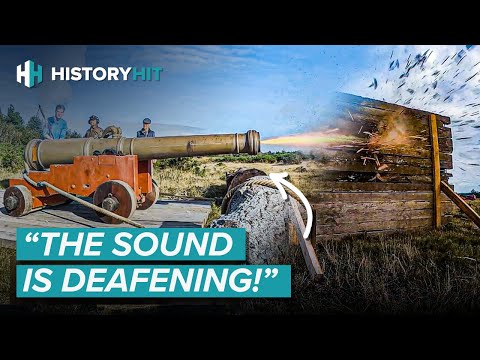
The simple answer to how far an old cannon could shoot is… it depends. Radically. The range of a cannon depended on a dizzying array of factors, from the cannon’s size and the type of propellant used, to the angle of the barrel and even atmospheric conditions. In general, though, we can say that cannons from the 18th and 19th centuries could typically achieve ranges from around one mile to just over two miles (1.6 km to 3.2 km). But that’s just the tip of the iceberg. To truly appreciate the capabilities (and limitations) of these impressive weapons, we need to delve deeper.
Understanding Cannon Range: A Complex Equation
Pinpointing a single range figure for “old cannons” is impossible due to the sheer variety of designs, powder types, and ammunition. Several critical elements influenced the effective range of these historic artillery pieces.
Key Factors Influencing Range:
-
Cannon Size and Caliber: Larger cannons, with wider bores (caliber), could accommodate larger charges of gunpowder and heavier projectiles. This generally translated to greater range. Think of the difference between a pistol and a rifle; the principle applies.
-
Powder Type and Charge: Black powder, the propellant of choice for centuries, came in varying grades. Finer grains burned faster, generating higher pressures and increased projectile velocity. The amount of powder used (the “charge”) was another crucial factor. More powder meant greater range, but also increased stress on the gun barrel.
-
Projectile Type: Round shot (solid iron balls) offered the greatest range due to their aerodynamic shape and concentrated mass. Other projectiles like grape shot (clusters of smaller balls), canister shot (a can filled with small projectiles), and explosive shells had shorter effective ranges.
-
Elevation Angle: The angle at which the cannon was fired significantly impacted range. A 45-degree angle would theoretically provide the maximum range in a vacuum (no air resistance). In reality, optimal elevation angles were usually less due to air resistance and the relatively low muzzle velocities achieved by black powder cannons.
-
Wind and Atmospheric Conditions: Wind speed and direction, as well as air temperature and density, could all affect the trajectory and range of a projectile. Gunners had to account for these variables when aiming.
The Evolution of Cannon Range Over Time
It’s also important to consider the era we’re talking about. An 18th-century cannon differed significantly from a mid-19th-century model. The advent of rifling in the 1850s was a game-changer. Rifling – spiral grooves inside the barrel – imparted spin to the projectile, stabilizing its flight and drastically improving accuracy and range.
Therefore, while an 18th-century smoothbore cannon might have struggled to reach beyond a mile with any accuracy, a rifled cannon from the American Civil War could effectively engage targets at distances approaching two miles or more.
Beyond Range: The Intended Purpose of the Cannon
It’s crucial to remember that maximum range wasn’t always the primary concern. Cannons were designed for specific roles on the battlefield or at sea.
-
Siege Cannons: These massive guns were designed to batter fortifications and required significant power, emphasizing penetration over extreme range.
-
Naval Cannons: Ship-mounted guns needed a balance of range, accuracy, and the ability to deliver devastating broadsides. Maneuverability was also a factor, influencing the size and weight of the guns that could be mounted.
-
Field Artillery: These more mobile cannons needed to be relatively lightweight and easy to deploy. This often meant a compromise in range for the sake of portability.
Ultimately, the “best” cannon was the one best suited to the task at hand, not necessarily the one with the longest range. The interplay of these factors shaped the art and science of artillery during the age of sail and the era of black powder. The Games Learning Society has a great history of explaining these details. Find out more at GamesLearningSociety.org.
Frequently Asked Questions (FAQs) about Old Cannon Range
Here are some frequently asked questions about cannon ranges:
1. How far could a Civil War era cannon shoot?
Civil War cannons, especially rifled cannons, could inflict damage on buildings and troops at longer distances than their predecessors. Generally, they could shoot effectively up to two miles away, although accuracy decreased at longer ranges.
2. How far could a 24-pound cannon shoot?
A 24-pounder cannon, like those used on ships like the USS Constitution, could fire round shot approximately 2400 yards (1.36 miles or 2.2 km).
3. What was the maximum range of an 18th-century cannon?
The maximum range of an 18th-century smoothbore cannon was approximately 1 mile (1.6 km). Accuracy at that distance was often poor.
4. How far could a 12-pound cannon shoot?
The maximum range of a 12-pounder cannon was around 1,800 metres (1,969 yd or 1.1 miles). However, the effective range, where a reasonable level of accuracy could be achieved, was closer to 900 metres (984 yd) for solid shot and 600 metres (656 yd) for canister shot.
5. How accurate were old cannons at long range?
During the black-powder era, with smoothbore cannons firing spherical projectiles, artillery fire was never precisely accurate at long ranges. Many factors affected the cannon’s overall accuracy.
6. Did cannonballs explode on impact?
Generally, no. Solid cannonballs did not explode on impact. Exploding shells existed, but they were designed to explode after a delay, using a fuse.
7. When did cannonballs start exploding?
The first recorded use of explosive shells was by the Venetians in 1376.
8. How powerful were cannonballs?
The casualties from round shot could be devastating. A cannonball fired directly into an advancing column was capable of passing straight through up to forty men. Even when most of its kinetic energy was expended, a round shot could still knock men over and cause gruesome injury.
9. How fast did a cannonball travel?
A standard Civil War cannonball (12 lbs) had a shot speed of approximately 250 miles per hour (820 ft per second).
10. At what size does a gun become a cannon?
The name cannon gradually came to be applied to every gun fired from a carriage or fixed mount and with a bore larger than one inch.
11. Were cannons ever rifled?
Yes. Rifled cannons began to appear in the mid-1850s. They had much better range, accuracy, and penetrating power than smoothbore cannons.
12. What was the largest naval gun ever built?
The largest calibre guns ever mounted on a ship were the nine 45.7 cm (18 inch) guns installed on the Japanese battleships Yamato and Musashi.
13. What factors made cannons lethal?
As rifling became more commonplace, the accuracy of the cannon was significantly improved, making them deadlier than ever, especially to infantry. Cannons were also widely used and lethal in both World War I and World War II.
14. What is a Napoleon field gun?
The Napoleon, technically a 12-pounder Field Gun, Model 1857, was a bronze, smoothbore cannon and a true “workhorse” of Civil War artillery for both the Union and Confederate armies.
15. What is the farthest a cannon has ever fired?
During World War I, the Germans built an artillery piece that fired the first manmade object to enter the stratosphere at a height of 26 miles. It was used to shell Paris from 75 miles away and had a range of 81 miles. This was an extreme example, far exceeding the range of typical cannons.