The Ultimate Gaming Powerhouse: Unveiling the Most Powerful Graphics Card
Fast answer first. Then use the tabs or video for more detail.
- Watch the video explanation below for a faster overview.
- Game mechanics may change with updates or patches.
- Use this block to get the short answer without scrolling the whole page.
- Read the FAQ section if the article has one.
- Use the table of contents to jump straight to the detailed section you need.
- Watch the video first, then skim the article for specifics.
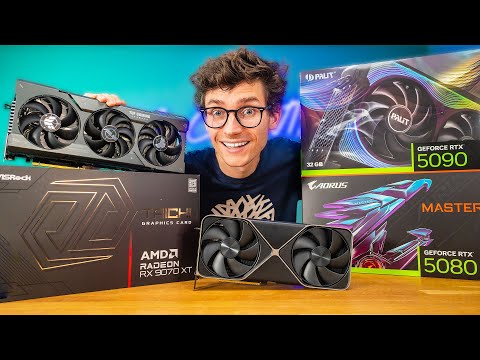
Without a shred of doubt, the Nvidia GeForce RTX 4090 reigns supreme as the most powerful graphics card for gaming currently available. It’s not just incrementally better; it’s a generational leap that redefines what’s possible in PC gaming. Its sheer power unlocks breathtaking visuals, silky-smooth frame rates, and allows you to crank every setting to the max without breaking a sweat. This card is more than just a component; it’s a ticket to the bleeding edge of gaming immersion.
Diving Deep: Why the RTX 4090 Dominates
The RTX 4090’s dominance stems from a potent combination of cutting-edge architecture, massive memory, and innovative technologies. Let’s break down the key factors that contribute to its unparalleled performance:
-
Ada Lovelace Architecture: Nvidia’s Ada Lovelace architecture is the heart of the RTX 4090. It features significant improvements over previous generations, including more CUDA cores, RT cores (for ray tracing), and Tensor cores (for AI-powered features like DLSS). These improvements translate directly into faster frame rates, more realistic visuals, and enhanced performance in AI-driven tasks.
-
Massive Memory Capacity: The RTX 4090 boasts a whopping 24GB of GDDR6X memory. This immense memory capacity is crucial for handling the massive textures and complex scenes found in modern games, especially at 4K resolution and beyond. The ample VRAM ensures smooth performance and prevents stuttering, even when pushing the limits of visual fidelity.
-
Ray Tracing Prowess: Ray tracing is a rendering technique that simulates the way light interacts with objects in the real world, resulting in incredibly realistic lighting, reflections, and shadows. The RTX 4090’s dedicated RT cores provide the horsepower necessary to handle ray tracing without sacrificing performance.
-
DLSS 3 (Deep Learning Super Sampling): Nvidia’s DLSS technology uses AI to upscale lower-resolution images to a higher resolution, resulting in sharper visuals with improved performance. DLSS 3, the latest iteration, takes this technology to the next level by generating entirely new frames using AI, further boosting frame rates and reducing latency.
-
Unmatched Raw Power: Beyond specific features, the RTX 4090 simply possesses unparalleled raw processing power. Its sheer computational capabilities allow it to blaze through even the most demanding games and applications, making it the undisputed champion of performance.
Alternatives and Considerations
While the RTX 4090 is the pinnacle of gaming performance, it comes at a premium price. For gamers on a tighter budget, there are alternative options to consider:
-
AMD Radeon RX 7900 XTX: AMD’s flagship GPU offers excellent performance at a more competitive price point. It’s a formidable contender, especially in rasterization performance (traditional rendering without ray tracing). The Radeon RX 7900 XTX is an absolute gaming dynamo with fantastic 4K performance at an acceptable price.
-
Nvidia GeForce RTX 4080/4070 Ti: These cards offer a compelling balance of performance and price, bringing many of the RTX 4090’s features to a more accessible level. The NVIDIA GeForce RTX 4070 Ti is clearly the better GPU when compared to older cards like the 3090.
-
Previous Generation GPUs: While not as powerful as the latest offerings, previous-generation GPUs like the RTX 3080 or RX 6800 XT can still deliver excellent gaming experiences at lower prices.
Ultimately, the best graphics card for you depends on your budget, the resolution and refresh rate you want to play at, and the types of games you enjoy.
The Future of Gaming and Graphics Cards
The gaming landscape is constantly evolving, with new technologies and demanding games pushing the limits of graphics cards. As game developers embrace ray tracing, path tracing, and other advanced rendering techniques, the need for powerful GPUs will only continue to grow.
Nvidia and AMD are locked in a constant battle for supremacy, pushing the boundaries of what’s possible in graphics technology. We can expect to see further advancements in architecture, memory technology, and AI-powered features in future generations of graphics cards.
For educators and researchers exploring the intersection of gaming and learning, resources like the Games Learning Society at GamesLearningSociety.org offer valuable insights into how games can be used for educational purposes.
Frequently Asked Questions (FAQs)
1. How much does the RTX 4090 cost?
The Nvidia RTX 4090 release price (MSRP) was $1599 at launch. Currently, the RTX 4090 retail price is $1699 on Amazon. Nvidia RTX 4090 used price is around $1500. Due to high demand and supply constraints, prices may fluctuate.
2. Is the RTX 4090 worth the money?
For gamers who demand the absolute best performance and are willing to pay a premium, the RTX 4090 is undoubtedly worth the investment. However, for more budget-conscious gamers, there are other excellent options available. A more expensive GPU will simply give you more eye candy—that’s when we go beyond simple frame rate expectations.
3. What power supply do I need for the RTX 4090?
Nvidia recommends a minimum 850W power supply for systems with the RTX 4090. However, depending on your other components, you may need a higher wattage PSU.
4. Can the RTX 4090 run 4K at 120 FPS?
Yes, the RTX 4090 is the most powerful GPU available and can definitely run at 4K at 120 FPS. When it comes to 4K gaming, the RTX 4090 is far and away the fastest GPU available.
5. What is DLSS, and how does it work?
DLSS (Deep Learning Super Sampling) is an AI-powered upscaling technology developed by Nvidia. It uses deep learning to upscale lower-resolution images to a higher resolution, resulting in sharper visuals and improved performance.
6. What is ray tracing?
Ray tracing is a rendering technique that simulates the way light interacts with objects in the real world, resulting in incredibly realistic lighting, reflections, and shadows. The RTX 4090 has dedicated RT cores to handle ray tracing efficiently.
7. Is the AMD Radeon RX 7900 XTX a good alternative to the RTX 4090?
Yes, the Radeon RX 7900 XTX is a great alternative. It offers excellent performance at a more competitive price point and is especially strong in rasterization.
8. How much VRAM do I need for gaming?
Even the Nvidia RTX 3080 which was one of the fastest GPUs in the world just a couple of years ago is showing signs of struggling in some modern games because it has “only” 10GB of VRAM. With that in mind, if you want to really future-proof your gaming PC, you want at least 12GB of VRAM. Modern games are becoming increasingly demanding, and having enough VRAM is crucial for smooth performance, especially at higher resolutions.
9. What is the weakest graphics card?
Nvidia GeForce GTX 480: The ‘G’ in GPU stands for grill. It was trying to make a massive GPU on TSMC’s 40nm, which was sort of broken. The end result was Nvidia’s worst technological blunder ever: Fermi, which powered the GTX 480.
10. What GPU do most pro gamers use?
The most popular graphics cards are calculated based on professional players with the NVIDIA GeForce RTX 3080 Ti being the most popular among them.
11. What GPU is better than 3080?
Both share the same TDP of 320 watts, demonstrating how impressive the RTX 4080 is when considering it is often double or more the performance metrics versus the RTX 3080. Yes, it does have that weird power adapter, and it often shares the huge cooler designs from the RTX 4090.
12. What GPU is stronger than PS5?
RTX 3060ti is a more powerful GPU than the RDNA 2 GPU in PS5. First of all PS5 GPU is 10 teraflops only. RTX 3060ti is 16.2 teraflops.
13. Is a GPU the same as a graphics card?
While the terms GPU and graphics card (or video card) are often used interchangeably, there is a subtle distinction between these terms. Much like a motherboard contains a CPU, a graphics card refers to an add-in board that incorporates the GPU.
14. Is 240Hz overkill?
It’s not overkill and is a worthy upgrade from 144Hz and certainly from lower refresh rates like 120Hz and 60Hz. In general, refresh rates on monitors are “the more the merrier”.
15. What graphics card do I need to run 120 FPS?
Nvidia GeForce RTX 3080 Ti ($963). The RTX 3080 Ti is a powerful graphics card that can deliver high frame rates in modern games, including Hogwarts Legacy. To maintain a consistent 120 FPS, the resolution and graphical settings used, and the performance of the CPU and other components in the system play a crucial role.