Unlocking Your Potential: Understanding the Proficiency Bonus in D&D
Fast answer first. Then use the tabs or video for more detail.
- Watch the video explanation below for a faster overview.
- Game mechanics may change with updates or patches.
- Use this block to get the short answer without scrolling the whole page.
- Read the FAQ section if the article has one.
- Use the table of contents to jump straight to the detailed section you need.
- Watch the video first, then skim the article for specifics.
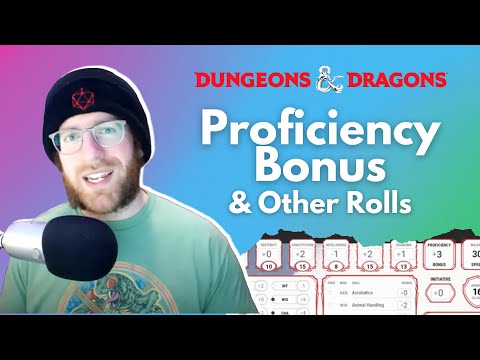
The proficiency bonus in Dungeons & Dragons (D&D) is a cornerstone mechanic that significantly enhances your character’s abilities as they progress. It’s a numerical bonus, determined by your character’s level, that’s added to various rolls to reflect their expertise and training in specific areas. Specifically, it’s added to ability checks, saving throws, and attack rolls for skills, tools, weapons, and spells your character is proficient with. It’s what separates a seasoned adventurer from a wide-eyed newbie.
Diving Deeper into Proficiency
Let’s unpack the proficiency bonus a bit more. Unlike ability modifiers, which are based on your character’s innate attributes like Strength or Intelligence, the proficiency bonus represents their learned skills and specialized knowledge. The two work in tandem, creating a balanced system where natural talent is amplified by dedicated training. At level 1, everyone starts with a proficiency bonus of +2. This bonus increases at specific level milestones, ensuring that your character’s effectiveness grows proportionally to the challenges they face. The progression is as follows:
- Levels 1-4: +2
- Levels 5-8: +3
- Levels 9-12: +4
- Levels 13-16: +5
- Levels 17-20: +6
The class advancement tables within the Player’s Handbook (or accessible through digital tools like D&D Beyond) clearly outline the proficiency bonus associated with each level.
How Proficiency Works
Proficiencies and Your Character
You gain proficiencies through various sources:
- Class: Each class grants proficiency in specific skills, saving throws, weapons, and sometimes tools.
- Race: Certain races offer additional skill proficiencies.
- Background: Your character’s background provides further skill and tool proficiencies, reflecting their past experiences.
- Feats: Some feats, like Skilled or Observant, offer extra proficiencies.
Applying the Bonus
The proficiency bonus is applied to:
- Attack Rolls: When attacking with a weapon or casting a spell you’re proficient with.
- Ability Checks: When making an ability check that uses a skill or tool you’re proficient in.
- Saving Throws: When making a saving throw you’re proficient in.
- Spell Save DC and Spell Attack Modifier: This applies to the DC needed for enemies to resist your spells and your own attack modifier when casting attack spells.
Double Proficiency: Expertise
The Rogue and Bard classes (among others) have a special feature called Expertise, which allows them to double their proficiency bonus for specific skills or tools. This essentially means they add twice their proficiency bonus to checks involving those chosen proficiencies. This ability further enhances their capabilities in their specialized areas, making them incredibly reliable.
FAQs: All About Proficiency
Here are 15 frequently asked questions about the proficiency bonus in D&D, designed to clarify common points of confusion and deepen your understanding of this important mechanic:
1. How is the proficiency bonus calculated?
The proficiency bonus is calculated based on your character’s overall level. It starts at +2 at 1st level and increases by +1 every four levels, reaching +6 at 17th level. The formula can be expressed as: 1 + 1/4 level (round up).
2. Where can I find my proficiency bonus?
Your proficiency bonus is listed in your class table within the Player’s Handbook or in digital character builders like D&D Beyond. It’s also clearly indicated on your character sheet.
3. Does D&D Beyond automatically add my proficiency bonus?
Yes, D&D Beyond automatically adds the proficiency bonus to all relevant rolls and calculations, provided you’ve correctly selected your proficiencies on your character sheet.
4. Can I add my proficiency bonus twice to the same roll?
No. The rules explicitly state that you cannot add your proficiency bonus more than once to a single roll or number. This prevents “stacking” proficiencies for an unrealistic boost.
5. How does multiclassing affect my proficiency bonus?
Multiclassing does not affect your proficiency bonus. Your proficiency bonus is based solely on your total character level, regardless of how many classes you’ve taken. So, a character who is level 5 Fighter/level 3 Rogue will have the same proficiency bonus as a level 8 Wizard.
6. What happens if I’m not proficient in a skill?
If you’re not proficient in a skill, you only add your relevant ability modifier to the ability check. You don’t get to add your proficiency bonus.
7. If I gain the same proficiency from two different sources (e.g., class and background), what happens?
D&D has a rule preventing redundant proficiencies. If you would gain the same proficiency from multiple sources, you typically get to choose a different proficiency of the same type. For example, if your class and background both grant proficiency in the Athletics skill, you would get to choose proficiency in a different skill instead.
8. Does the proficiency bonus apply to armor class (AC)?
No, the proficiency bonus is never added to your Armor Class (AC). AC is determined by the armor you wear, your Dexterity modifier, and any other specific features that grant AC bonuses. However, wearing armor you are not proficient with can impose disadvantages, such as on attack rolls, ability checks, or saving throws.
9. How does Expertise work?
Expertise, typically granted by the Rogue and Bard classes, allows you to double your proficiency bonus for specific skills or tools you’re proficient in. This significantly boosts your reliability in those areas.
10. Can I gain proficiency in a tool or language?
Yes. The Player’s Handbook outlines rules for training in new tool proficiencies or languages during downtime. It typically involves spending time and money to learn from a trainer. Skills are technically not on that list, but many DMs may allow it.
11. Do I add my proficiency bonus to spell damage rolls?
No, you generally do not add your proficiency bonus to spell damage rolls. Spell damage is typically determined by the spell itself and potentially modified by your ability modifier (if the spell specifies).
12. Is there a level cap in D&D?
Yes, the level cap in D&D 5e is level 20. Once you reach level 20, you can no longer gain additional levels or increase your proficiency bonus beyond +6.
13. Do I add proficiency bonus to Cantrips?
For cantrips and other spells, both the spell save DC and spell attack modifier include proficiency bonus. Your character’s proficiency bonus is included in both formulas.
14. How does Proficiency Bonus change when leveling up?
For most builds, leveling up is the only way to increase proficiency bonus. It’s certainly the most reliable way because the bonus increases by +1 every 4 levels for everyone – regardless of class, race, etc.
15. What is a Tiefling proficiency bonus?
Weapon and Armor Proficiency: A tiefling is automatically proficient with all simple and martial weapons, light armor, and shields. Resistance to cold 5, electricity 5, and fire 5. Spell-Like Ability: 1/day—darkness. Caster level equals the tiefling’s class levels. +2 racial bonus on Bluff and Hide checks.
Mastering Proficiency: A Key to Success
Understanding the proficiency bonus is essential for maximizing your character’s effectiveness in D&D. By carefully choosing your class, race, background, and feats, you can strategically acquire proficiencies that complement your playstyle and strengths. The proficiency bonus is not just a number; it’s a representation of your character’s growth, expertise, and potential. Remember that resources like the Games Learning Society (https://www.gameslearningsociety.org/) also emphasize the educational benefits of tabletop role-playing games, including strategic decision-making in areas like character building. Mastering the proficiency bonus will not only make you a more effective player, but will also enhance your overall enjoyment of the game! This valuable game mechanic is a key to unlocking your potential and contributing to a more exciting and rewarding D&D experience.