Unveiling the Mystery: Why is Halo Rated M?
Fast answer first. Then use the tabs or video for more detail.
- Watch the video explanation below for a faster overview.
- Game mechanics may change with updates or patches.
- Use this block to get the short answer without scrolling the whole page.
- Read the FAQ section if the article has one.
- Use the table of contents to jump straight to the detailed section you need.
- Watch the video first, then skim the article for specifics.
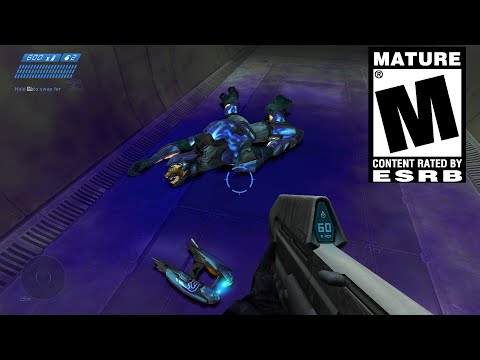
Halo, the iconic first-person shooter franchise that has captivated millions, carries a Mature (M) rating from the Entertainment Software Ratings Board (ESRB). This rating, which signifies the game is generally intended for audiences aged 17 and older, stems primarily from the presence of violence, blood and gore, and, in some instances, mild language. It’s a classification that often sparks debate, particularly among parents and younger gamers eager to delve into the Halo universe. Let’s dissect the specific elements that contribute to this M rating and explore the nuances within the franchise’s content.
Delving Deeper: The Content Breakdown
The ESRB’s rating isn’t based on a single factor but a holistic evaluation of the game’s content. For Halo, the key elements are:
-
Violence: Halo revolves around combat, often intense and frenetic. Players use a variety of weapons, from pistols and assault rifles to plasma rifles and energy swords, to eliminate both human and alien enemies. While not always graphically explicit, the sheer volume of combat contributes significantly to the M rating.
-
Blood and Gore: While Halo is not as gratuitous as some other M-rated titles, blood is present when characters are shot or injured. Some games, particularly earlier entries in the series and those featuring the Flood, contain elements of gore. The Flood are a parasitic alien lifeform that reanimates corpses, leading to more disturbing imagery.
-
Mild Language: The language used in Halo is generally considered mild compared to other M-rated games. Instances of profanity such as “bullsht,” “ashole,” and “bastard” can be heard in dialogue or radio chatter, but the use of stronger expletives is typically avoided.
It’s essential to remember that the ESRB considers the overall context and frequency of these elements when assigning a rating. While individual instances might seem minor, their cumulative effect leads to the M classification.
Halo’s Evolving Rating Landscape
It’s important to note that not all Halo games have the same level of mature content. For example, some spin-offs, like Halo Wars and Halo Wars 2 (both real-time strategy games), often receive lower ratings due to their different gameplay style and reduced emphasis on graphic violence. Halo 5: Guardians was also noted for a more streamlined presentation of violence, contributing to a T rating. Halo Infinite holds a PG rating in Australia. These inconsistencies highlight the importance of examining each game individually rather than assuming a blanket M rating across the entire franchise.
More Than Just Violence: Thematic Elements
While violence, blood, and language are the primary drivers of the M rating, thematic elements also play a role, especially in the narrative-driven campaigns. Halo deals with mature themes such as:
- War and Sacrifice: The Halo storyline explores the brutal realities of war, the sacrifices made by soldiers, and the psychological toll of constant combat.
- Artificial Intelligence: The relationship between humans and advanced AIs like Cortana raises ethical questions about sentience, autonomy, and the potential dangers of unchecked technology.
- Existential Threats: The threat posed by the Covenant and the Flood represents existential challenges to humanity, forcing players to confront themes of survival and extinction.
These thematic elements, while not explicitly violent or graphic, contribute to the game’s overall mature tone and solidify the M rating.
The Impact of the M Rating
The M rating has implications for both consumers and retailers. Many stores have policies preventing the sale of M-rated games to individuals under 17 without parental consent. The rating can also influence marketing strategies, as some platforms may restrict advertising for M-rated titles.
For parents, the M rating serves as a guideline, but ultimately, the decision of whether a child should play a particular game rests with them. It’s recommended that parents research the specific content of each Halo game and consider their child’s maturity level before making a decision. You can explore resources such as the Games Learning Society at https://www.gameslearningsociety.org/ to learn more about the educational and social impact of video games.
Frequently Asked Questions (FAQs) About Halo’s Rating
Here are 15 frequently asked questions that delve deeper into the nuances of Halo’s rating and its content.
1. Is Halo appropriate for 10-year-olds?
Generally, no. The M rating indicates that Halo is designed for audiences 17 and older. The violence, blood, and mild language are considered unsuitable for younger children. However, parental discretion is advised, and some parents may find certain Halo titles acceptable for mature 10-year-olds.
2. Why did Halo 5 become T-rated?
Halo 5 received a T rating due to a reduction in graphic violence and gore compared to previous installments. While violence is still present, it’s less explicit, contributing to the lower rating.
3. Does Halo 1 have blood in it?
Yes, Halo: Combat Evolved features blood when enemies are shot. While not excessively gory, the presence of blood contributes to the game’s M rating. The remastered version has updated graphics that make the blood more noticeable.
4. Can you turn off blood in Halo?
Some Halo games offer options to reduce or disable blood effects in the settings menu. This can be a useful feature for parents who want to mitigate the game’s mature content.
5. Is Halo 3 gory?
Halo 3 features minimal blood and gore. Compared to other M-rated games, it is considered relatively tame in terms of graphic content. However, the violence and mild language still justify the M rating.
6. Does Halo 3 have bad language?
Halo 3 contains some mild profanity, such as “bullsht,” “ashole,” and “bastard.” The language is not pervasive, but it’s present in dialogue and radio chatter.
7. Should a 7-year-old play Halo?
It is generally not recommended. The M rating indicates that Halo is not suitable for children under 17. The violence and thematic elements are considered too mature for a 7-year-old.
8. Is Halo 4 kid-friendly?
Halo 4 is more violent than some previous entries, with enhanced visual effects and more dramatic combat animations. While there is no foul language or excessive gore, the level of violence makes it unsuitable for younger children.
9. Why is Halo Infinite rated T?
Halo Infinite received a T rating, signifying it is generally suitable for ages 13 and up. Its level of violence, while still present, is less graphic and intense compared to the M-rated Halo games.
10. Does Halo have swearing?
Yes, some Halo games contain mild profanity. However, the use of strong expletives like the F-word is generally avoided. Halo CE and Halo 2 contain the strongest language in the series however it’s still mild and tame.
11. Can an 11-year-old play Halo 2?
Halo 2 is rated M for mature audiences, so it is not recommended for an 11-year-old. It contains a lot of blood, gore, and scariness.
12. Why is Halo not for kids?
Halo contains blood, mild language and violence which is not recommended for kids.
13. Does Halo 5 have bad language?
The word “a*s” appears in the dialogue, as well as occasional taunts/insults (e.g., “I have copulated…with your genetic progenitors!”; “Your father was a filthy colo and your mother was a hole in the wall!”).
14. Is Halo Infinite OK for kids?
Halo Infinite received a T rating from ESRB and has a PG rating in Australia. As long as they can handle violence, Halo Infinite is fine for 11 to 12 year olds.
15. Does Halo ban cheaters?
Once a cheater has been detected, the platform issues bans correlated to the severity of their cheats. These bans can vary in scope (account bans or hardware bans) as well duration (temporary or permanent).
Conclusion: Understanding the M Rating
The M rating for Halo is a result of a combination of factors, including violence, blood and gore, and mild language. While some games in the franchise are more graphic than others, the overall content is considered suitable for mature audiences aged 17 and older. Parents should carefully consider the content of each game and their child’s maturity level before allowing them to play. By understanding the reasons behind the M rating, consumers can make informed decisions about whether Halo is appropriate for themselves or their families.